 Loading... Please wait...
- My Account
- Order Status
- Buy Voucher - Buy Voucher
- View Cart

- Home
- Support
- About Us
- Terms and Conditions Of Use
-
Article
- Essential Spare Parts for Maintaining Industrial Printers
- Everything You Need to Know About Custom Banner Printing
- How to clean a clogged print head
- How to Make a Statement with a Custom Banner
- Ricoh G6 Printhead: You Need to Know
- Toshiba CF3R Printhead: A Next-Level Industrial Recirculation Printhead
- 500 ChatGPT Prompts 2024-Unlocking Creativity and Productivity
- Setting cutting width / Setting Page Length Graphtec Printer
- Aligning the Print Head Canon
- Setting Up Your Roland Printer on Your Network
- Comprehensive guide to epson printer troubleshooting and service
- What is a printed circuit board?
- Shipping & Returns
- Contact Us
Categories
Our Newsletter


Toshiba CF3R Printhead: A Next-Level Industrial Recirculation Printhead
Toshiba printheads are familiar to people in the inkjet industry. Toshiba has been manufacturing and developing printheads for nearly 20 years. Toshiba printheads have always been known for their ultra-long life and high-precision performance. They have excellent performance in graphics, ceramics, advertising, and other industries and have long been favored by many excellent inkjet equipment companies, such as Riso, EFI, Kuaidaping, Canon Oce, and Mimaki.
In the past, Toshiba printheads were used by some international inkjet giants, and for many years, they were both sacred and mysterious in the minds of the public. It was not until 15 years later that Toshiba printheads began to be widely promoted and applied in China and became familiar to more and more Chinese consumers. Today, Toshiba printheads are being used in more and more industrial inkjets with their unique technical advantages. This article provides a comprehensive analysis of the innovative technology and advantages of Toshiba printheads from a professional perspective.
Toshiba printheads mainly include the CE4 series, the CF1 series, and the CF3 series. Today, we will introduce the CF3R printhead designed for industrial inkjet applications. The Toshiba CF3R printhead is a high-precision, high-grayscale internal circulation industrial head.
Toshiba CF3R Printhead Specifications
| Print Method | On-demand piezo technology |
| Ink recirculation through all channels | 300 npi * 2 colors |
| Print Width | 53.91 mm |
| Nozzles | 639*2 colors |
| Nozzle Resolution | 300 npi * 2 colors |
| Number of Lows | 2 |
| Nozzle Spacing (Row to row distance) | 7.94 mm |
| Greyscale Level | 6 levels/0~5 drops |
| Drop Volume | 20 pl/5 drops |
| Minimum Drop Volume | 3~4 pl |
| Frequency | 9.2 kHz/5 drops |
| Power Supply Voltage for Driving the Head | +7V~+15V, -7V~-15V |
| Power Supply Voltage for Driving Circuit | 5V, 24V |
| Ink Type | UV-curing & oil-based |
| Built-in Temperature Sensor | Included |
| Head Cooling Method | Water-cooling (including water cooling port) |
| Size, Weight | Ink Re-circulation Structure |
Toshiba CF3R Printhead Advantages
Advantage 1—Internal Circulation Technology
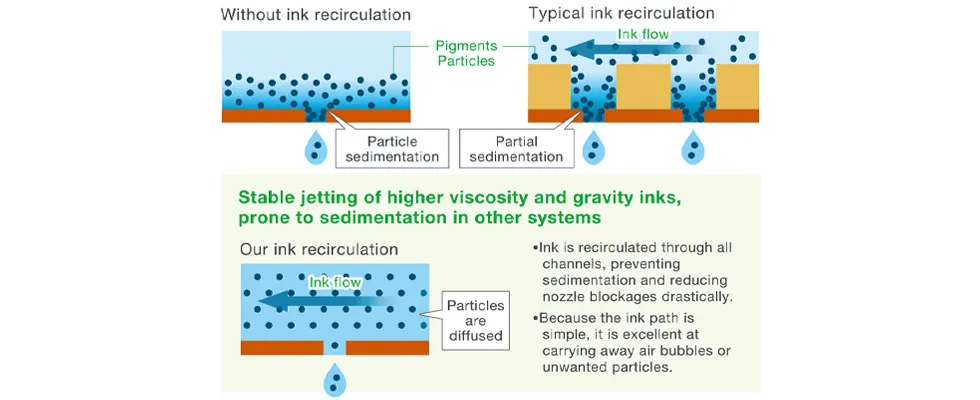
Patented Internal Circulation Technology
The high-flow internal circulation technology that flows directly through all nozzle channels has great inherent advantages over other printhead ink chamber circulation.
Application Value
- Stability: The internal circulation directly removes bubbles and impurities in the spray chamber during printing to ensure the stability of continuous printing.
- Moisture Retention: Greatly prolongs the standby time, starts spraying immediately, and reduces the maintenance and cleaning frequency.
- Printhead Life: The internal circulation self-repair function greatly reduces the nozzle clogging caused by oblique spraying, extending the printhead life.
- Ink Adaptability: The internal circulation prevents the precipitation of large-particle color ink and adapts to a wider range of ink applications, such as UV white ink, ceramic/glass inorganic ink, special varnish and coating, quick-drying ink, or other large-particle high-viscosity ink.
Advantage 2—Ultra-high-resolution finishing technology
The world’s unique single-row 300 npi nozzle processing technology
CF3R is the world’s only industrial printhead with a single-row 300 npi nozzle, and the 600npi nozzle is composed of only two rows of nozzles
Note: R** is 150 npi per row, X** is 180 npi per row, and K** is 180 npi per row
Application value
- Reduce printing color difference: Avoid uneven colors in 1pass caused by differences in multiple columns of nozzles, such as dark and light rows.
- Improve landing accuracy: Avoid the decrease in accuracy caused by the landing error of different columns of nozzles.
- Reduce color registration differences: Reduce the color registration differences of each column of the nozzle, and reduce the appearance of miscellaneous lines, ghosting, or jagged edges in printing
Advantage 3—High ink droplet speed + high drop point accuracy
Ink droplet flight speed
- The ink droplet speed reaches more than 10 m/s
- Reduce the drop point difference of different dot types, especially the drop point accuracy of small ink droplets
- High injection force is suitable for high drop and high gap printing
Injection angle error
Injection angle: within 1.3 mrad, which is equivalent to the ejected ink droplets falling on the bull’s eye of 10cm at 50 meters away
The small injection error greatly ensures the drop point accuracy of 3~4 pl ink droplets
Advantage 4- small ink droplets + high grayscale
Minimum 3~4 pl ink droplets, excellent ink dot formation, providing extremely delicate proofing effect
6-level grayscale (4~20 pl) simultaneously ensures color saturation and smooth transition gradient
Advantage 5—Individual nozzle waveform fine-tuning technology
Fine-tuning is a waveform control technology
The inkjet volume and jet speed of each nozzle can be finely adjusted through the waveform
Application value
- Blocked hole cover By fine-tuning the ink volume of the adjacent nozzles of the blocked nozzle, the white line phenomenon caused by the blocked nozzle can be covered
- Improve the uniformity of color blocks: Through fine-tuning, the deep and shallow lines and deep and shallow lines caused by nozzle manufacturing errors can be effectively reduced
- Seamless splicing of multiple nozzles: Adjust the nozzles at the joint position of the printheads to spray ink and solve the line stripes generated when multiple printheads are spliced and printed
Printhead Advantages—Summary
With its five unique technical advantages, Toshiba’s CF3R printhead has greatly improved printing accuracy, jet height, printhead stability, printhead life, and ink compatibility. It is particularly suitable for single-pass and special ink applications, providing a more mature and reasonable solution for various complex and difficult industrial inkjet scenarios.
Which is Better, The Toshiba CF3R Printhead or The Ricoh G6?
Ricoh G6 is currently popular, but do you know which printhead is better than G6 in printing high-drop products? This article reveals which is better, the Toshiba CF3R printhead or the Ricoh G6 printhead.
The parameters of the Toshiba CF3R printhead have been introduced before. Compared with other printheads, what are the advantages? In this issue, we will compare the Ricoh G6 printhead with the Toshiba CF3R printhead to see which of the two printheads has more advantages.
Next, we compare the performance of the two types of UV printers from the printhead parameters and configuration:
1. Printhead droplet size
The smallest droplet of the Toshiba CF3R printhead is 3PL, and the smallest droplet of the Ricoh G6 printhead is 5PL. In this respect, the smaller the droplet, the better the printing precision. Therefore, the Toshiba CF3R prints products with better precision.
2. Printing speed
When printing flat products at the same time, and the requirements are not very high, the Toshiba CF3R printhead has a printing speed of 20-30 square meters per hour; the Ricoh G6 printhead has a printing speed of 30-40 square meters per hour. If we only talk about the printing speed, the Ricoh G6 is slightly better. Of course, the above is only a theoretical speed. If we compare actual printing, the G6 is also slightly faster.
3. Printhead unit price
The Toshiba CF3R printhead and the Ricoh G6 printhead are both 2-color. The unit price of the two printheads is not very different.
4. High-drop performance of printheads
The Toshiba CF3R can print with a height difference of 20 mm; the Ricoh G6 is 18 mm. In this respect, they are evenly matched. At present, both printhead devices are equipped with magnetic suspension, and Toshiba CF3R is slightly better at printing high drops.
5. Market applications
Toshiba CF3R is mainly used for printing high-drop products, such as toy products. G6 is widely used in the UV printer industry, such as advertising decoration, color printing processing, toys, etc.
Through the above data comparison, we found that the two printheads have their own advantages and disadvantages, and they are comparable. As for which printhead is better? This is difficult to evaluate. Both devices have been on the market for about 6 years, and there is not much difference in technical perfection.


