 Loading... Please wait...
- My Account
- Order Status
- Buy Voucher - Buy Voucher
- View Cart

- Home
- Support
- About Us
- Terms and Conditions Of Use
-
Article
- Essential Spare Parts for Maintaining Industrial Printers
- Everything You Need to Know About Custom Banner Printing
- How to clean a clogged print head
- How to Make a Statement with a Custom Banner
- Ricoh G6 Printhead: You Need to Know
- Toshiba CF3R Printhead: A Next-Level Industrial Recirculation Printhead
- 500 ChatGPT Prompts 2024-Unlocking Creativity and Productivity
- Setting cutting width / Setting Page Length Graphtec Printer
- Aligning the Print Head Canon
- Setting Up Your Roland Printer on Your Network
- Comprehensive guide to epson printer troubleshooting and service
- What is a printed circuit board?
- Shipping & Returns
- Contact Us
Currency Converter


Categories
Add to Wish List
Related Products


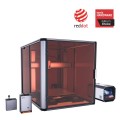
You Recently Viewed...
Snapmaker Air Purifier


Product Description
Snapmaker Air Purifier
A New Level of Air Safety
Chemicals such as PM (Particle Matters) and VOCs (Volatile Organic Compounds) can be released when you 3D print with or laser engrave on certain types of materials. You can further filter them with a Snapmaker 2.0 Air Purifier.
- Exclusive Filter Cartridge
- Filter Detection
- Filter Life Detection
- Fan Speed Control
- Status Light
- Full-metal Design
In the Box
- Air Purifier × 1
- Cover × 1
- Filter Cartridge × 1
- Hose × 1
- Hose Clamp × 2
- Quick Start Guide × 1
- Connecting Cable × 1
- Power Adapter × 1
The Exact Filter Cartridge You Need
Tailor-made filter cartridge for your Snapmaker 2.0, with five layers of different filters consolidated into one, it is designed to absorb what's actually emitted during laser engraving or 3D printing process [1].
G4 Filter for Coarse Filtration
Aims at relatively bigger particles (≥ 5 μm in diameter). It filters out more than 90% of PM10 and PM5.
F9 Filter for Finer Filtration
Works at particles that measure 1 μm or above in diameter. It filters out more than 95% of PM10, PM5 and PM2.5.
Customized Activated Carbon Filter
A dense pack of activated carbon is also added to absorb VOCs that no other filters can capture. Unpleasant odor is no longer a problem.
Ultra-dense HEPA H13 Filter
Two layers of 70 mm-thick HEPA H13 filter as the final stage gate. They are able to trap up to 99.97% of airborne particles of all sizes, including PM0.3 that are known to be the most penetrating particles in the air.
Long Live the Filter Cartridge
Efficiency is not all that matters. The different levels of filter are arranged in certain order inside the cartridge to maximize its lifespan, so that you won't need to replace the cartridge until it gets fully used.
Filter Life Detection
Snapmaker 2.0 carries out a real-time monitoring on the Filter Cartridge and shows its lifespan on the Touchscreen. It lets you know when it's time to pop in a new one.
Be in the Know
The built-in LED strip shows you how the Air Purifier is working through its color change, flowing, breathing, and flashing.
- Unpowered
- Working normally
- Connecting to the Controller
- Filter Cartridge taken out
- Low filter life or blocked inlet/outlet
- Danger
Fan Speed Control
Tap on the Touchscreen to set fan speed for different types of job [3].
Full-metal Design
Both the Enclosure and the Air Purifier are neatly designed as ever. The CNC-machined aluminum beams and shell, with their surface anodized, deliver great durability, super-fine texture, a consistent silver gray looking, as well as well-sealed machine bodies. They're powerful, yet adorable.
Creativeness knows no bounds
Along with the CAN Hub, you can use the Enclosure and the Air Purifier together with all the existing and upcoming Snapmaker 2.0 addons.
Specifications
| Air Inlet Diameter | 70 mm |
| Air Volume | 150 m³/h |
| Cable Length | 2,000 mm |
| Clamp Diameter | 65–89 mm |
| Filter Cartridge Dimensions (W × D × H) | 191 × 229 × 308 mm |
| Filter Cartridge Lifespan | Approx. 3 months |
| Filter Cartridge Weight | 2.4 kg |
| Filtration Efficiency (0.3–0.5 μm) | 95.9% |
| Hose Dimensions (Diameter × L) | 75 × 2,000 mm |
| Input Voltage | AC 100 V – 240 V |
| Maximum Noise (With Hose) | 65 dB |
| Package Dimensions (W × D × H) | 316 × 360 × 595 mm |
| Package Weight | 12.7 kg |
| Power Cord Length | 2,000 mm |
| Rated Current | 5A |
| Rated Power | 120 W |
| Rated Voltage | 24 V DC |
| Operating Temperature | 0°C–35°C |
| Storage Temperature | -4°C–45°C |
| Outer Shell Material | Aluminum alloy |
| Approvals | CE, FCC, UL62368, IC, RCM, ROHS, WEEE |
[1] Using the Air Purifier when printing with ABS or other thermo-sensitive filaments may lead to poor printing quality. If you need to filter 3D printing emissions, it's recommended to turn on the Air Purifier after printing job is finished.
[2] The data is sourced from the Snapmaker Testing Laboratory. With the enclosure and the enclosure fan in use, the 1.6W, 10W, 20W, and 40W laser modules were used to continuously cut 2mm, 3mm, and 5mm basswood sheets for 5 minutes, while the 2W laser module was used to cut a 3mm dark acrylic sheet. The particulate matter (PM) and total volatile organic compound (TVOC) concentrations were measured at the exhaust duct outlet.
Due to variations in usage conditions and environments, the specific performance and results in actual use may differ from the provided data. Snapmaker shall not be held responsible for any discrepancies or consequences resulting from such environmental changes.
[3] The Touchscreen UI is subject to change due to iterations.
[4] This data is obtained under the condition of typical laser use, and is for reference only.
[5] 0.3 μm corresponds to the worst case. Particles that are larger or smaller can be filtered with even higher efficiency.
Find Similar Products by Category

Best Selling
-
 $9.03
$9.03
-
 $3,643.44
-
 $28.91
-
 $105.02
-

$105.34$82.26
-
 $6.84
$6.84
-
 $0.91
$0.91
-
 $102.45
-
 $58.91
-
 $135.75
-
 $2.05
$2.05
-
 $48.35
-
 $0.74
$0.74
-
 $169.65
-
 $19.81
-
 $396.86
-
 $95.05
-
 $150.75
-
 $18.58
-
 $21.85


